
Research / Projects / Evidential Physics-Informed Neural Networks
![]()
Link to our work on the arXiv: https://arxiv.org/abs/2509.14568
Github Repository: https://github.com/HaiSiong-Tan/E-PINN
This work was presented at the 30th International Conference on Technologies and Applications of Artificial Intelligence (TAAI 2025), and at the International Conference on Scientific Computing and Machine Learning (SCML 2025)
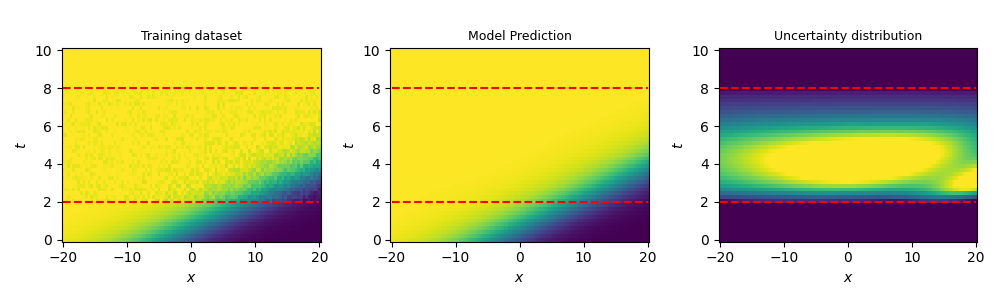
In this work, we formulate a novel class of Physics-Informed Neural Networks based on the principles of Evidential Deep Learning, which can be used to model a wide class of physical problems describable by differential equations with a robust uncertainty quantification scheme. Physics-Informed Neural Networks have been used since 2017 to model mainly biological and engineering problems with a blend of data-driven and neural network-based approach. Typically, the model is trained using conventional regression-type loss functions together with a regularizer that enforces the constraint arising from the differential equation description. This framework can be applied to enable learning unknown parameters of the modeled partial differential equations (PDE). In our work, we propose an extension of the standard formalism such that the dependent target variables and the unknown parameters of the PDE can be predicted with a measure of statistical confidence or uncertainty. This completes the framework as a data-driven method since data-mining in scientific computing should ideally be accompanied by some knowledge of the uncertainty in the inferred parameters or predicted variable.
In our paper “Evidential Physics-Informed Neural Networks for Scientific Discovery”, we applied our framework to model 1D Poisson equation, 2D Fisher-KPP equations, and the Bergman equations (a coupled set of ODEs). The picture below shows the model (applied to Fisher-KPP eqns.) correctly generating elevated uncertainty estimates (rightmost diagram) for the region for which synthetic noise has been purposely added (leftmost diagram showing Gaussian noise between red dashed lines).
For the PDEs examined in our work, we have found our framework to perform significantly better than Bayesian-PINN, Deep Ensemble method, and Monte Carlo dropout methods adapted to Physics-Informed Neural Networks in the aspect of the degree of calibration of the uncertainty distribution.
We hope that our work will inspire more in-depth exploration of E-PINN in various areas of scientific computing and inverse problems !